
You are about to approve a DeFi transaction on a network you rarely use. The token balance looks familiar, the dollar value appears plausible, and the wallet prompts you to sign. Yet the transaction is directed to an unfamiliar contract, the network fee is denominated in a different asset, and the expected result is not obvious. This is the everyday problem a multi-chain wallet is meant to reduce: not merely holding keys, but helping a user understand what those keys are being asked to authorize.
For US-based DeFi users, installing a browser wallet is therefore not a trivial software download. It is a security decision and a usability decision at the same time. A wallet such as Rabby sits between a decentralized application and the user’s signing device. Its value depends on how clearly it represents networks, accounts, assets, permissions, and transaction effects—and on whether the user still verifies the important details rather than treating the interface as an oracle.
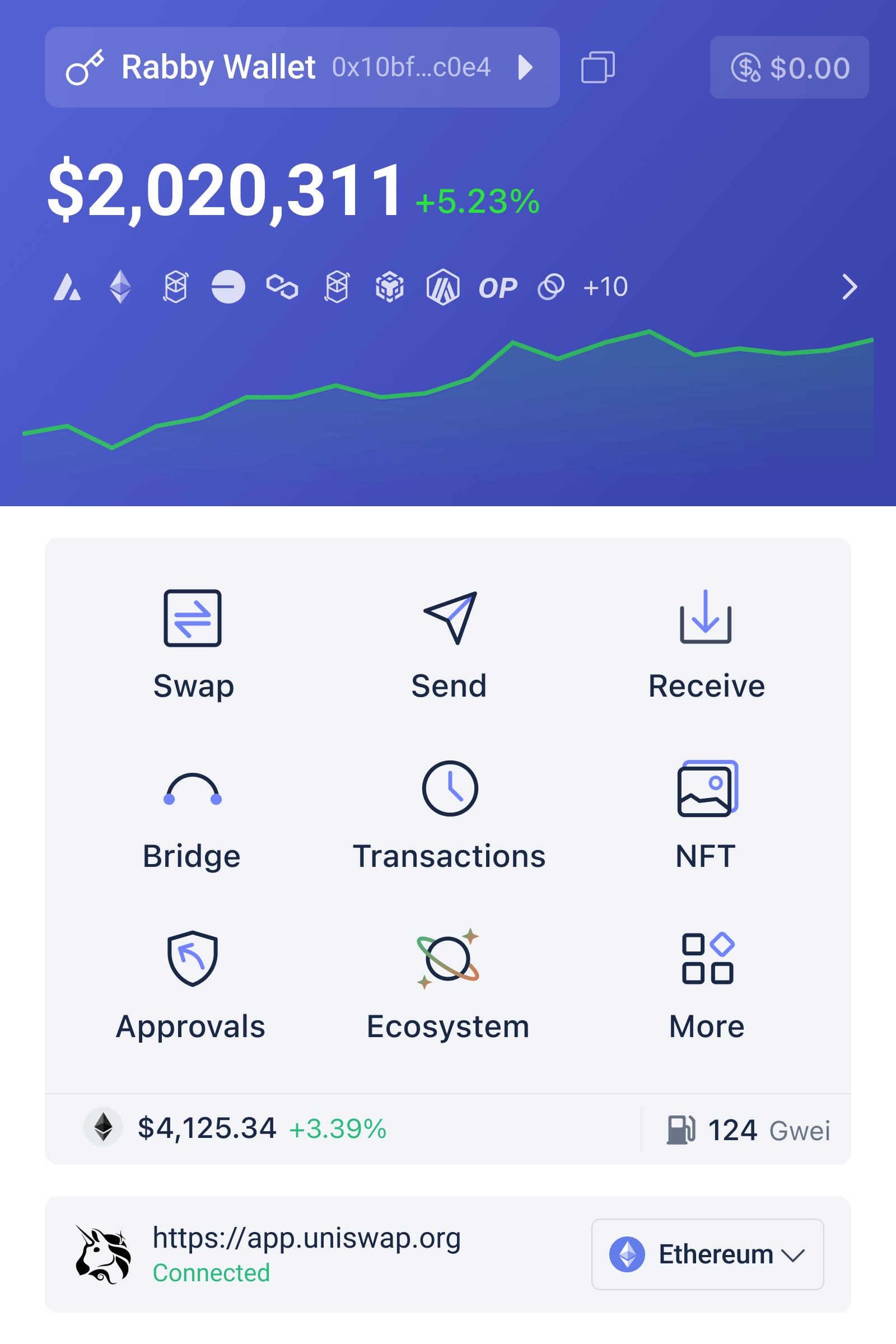
Why multi-chain wallets are more than account switchers
A blockchain wallet does not usually store coins in the way a physical wallet stores cash. The assets remain recorded on blockchains, while the wallet manages private keys or access to them and produces digital signatures. A decentralized application creates a transaction request; the wallet displays that request; the user approves or rejects it; and the relevant network processes it. This distinction matters because a wallet cannot reverse a confirmed transaction. Its most important protective function occurs before signing.
In a single-chain environment, the user still faces contract risk, phishing, and irreversible mistakes. Multi-chain activity adds another layer: context. The same token symbol may exist on several networks, a bridge may create a wrapped representation of an asset, and a decentralized exchange may require a sequence of approvals before a swap can occur. A wallet that supports multiple networks must help the user answer basic but consequential questions: Which chain is active? Which account is signing? What asset is being spent? What contract receives permission? What network fee is required?
This is why the strongest mental model is not “a wallet that contains all my assets.” It is “a transaction interpreter connected to several settlement environments.” The wallet does not eliminate blockchain complexity; it can make some of that complexity visible at the moment when visibility is most valuable. That is a more modest claim, but also a more useful one.
Rabby is generally positioned around this kind of multi-chain DeFi workflow, with a browser extension acting as the interaction layer for compatible decentralized applications. Before installing, users should obtain the software through a source they can independently verify and check that the domain, extension publisher, and requested permissions are consistent. A guide to the rabby extension may help explain the download process, but readers should still treat search advertisements, unsolicited messages, and copied download pages as potential phishing paths.
What happens when a DeFi transaction reaches the wallet
Suppose a user connects a wallet to a decentralized exchange and selects a token swap. The application constructs a transaction or message request. Depending on the operation, the request may call a smart contract, transfer an asset, grant an allowance, or ask the user to sign an off-chain message. These are not equivalent actions. A token approval can authorize a contract to spend a specified asset, sometimes within a scope that is broader than the immediate trade. A message signature may not move funds immediately, but it can still have consequences if a malicious application uses it in a later authorization flow.
The wallet’s job is to translate technical data into a human-checkable representation. This can include the destination contract, network, value, gas estimate, token changes, and possible warnings. Such simulation and warning systems are useful because raw calldata—the encoded instructions submitted to a smart contract—is difficult for most people to inspect directly. They can reveal a mismatch between what a website claims will happen and what the transaction appears likely to do.
That assistance has a boundary. A simulation is an estimate under particular blockchain conditions, not a guarantee about every later outcome. Contract state can change, oracle inputs can move, a transaction can be reordered, and a protocol can contain logic that is difficult to model. Warning systems may also lack complete information about a newly deployed contract. The correct conclusion is not that transaction previews are unreliable; it is that they are evidence for a decision, not a substitute for one.
This distinction corrects a common misconception. Wallet security is not mainly about finding a screen that says “safe.” It is about reducing the distance between a user’s intention and the transaction’s actual effects. If the user intends to swap one asset for another but the wallet shows a broad approval, an unexpected recipient, or a different network, that discrepancy deserves investigation before signing.
Installation is part of the security model
Downloading a browser extension creates a supply-chain question before any DeFi transaction occurs. A convincing imitation can copy logos, wording, and screenshots while directing the user to a malicious extension. In the US, where users commonly access DeFi through desktop browsers and hardware wallets, the practical discipline is straightforward: start from a source you trust, confirm the publisher and permissions, keep the browser updated, and avoid installing software from a link sent through an unsolicited direct message.
During setup, the recovery phrase is the most sensitive item in the entire process. It is not a password-reset code and should never be typed into a website, sent to support, stored in an ordinary cloud note, or photographed casually. Anyone who obtains it can generally recreate control of the account elsewhere. Conversely, a wallet provider cannot restore a lost phrase in the manner of a conventional financial institution. Users should also distinguish between an ordinary software wallet and a hardware wallet: the latter keeps signing operations on a separate device, but it does not make a malicious transaction harmless.
A sensible installation workflow includes a small test. After creating or importing an account through a legitimate interface, verify the wallet address on the device or platform being used, connect only to a known application, and begin with a transaction whose value is limited. Check the selected network and fee asset before approving. This may feel slow, especially when markets are moving, but speed is often an enemy when the transaction is irreversible.
Users should also separate accounts by purpose. A frequently connected account used for experimental protocols should not necessarily hold long-term savings or valuable non-fungible tokens. This is not a perfect defense: a compromised device, exposed recovery phrase, or careless signature can affect more than one account. Still, compartmentalization limits the damage from a single bad interaction and makes transaction history easier to interpret.
The trade-off between convenience and control
Multi-chain access reduces the friction of moving between ecosystems, but convenience can create a dangerous illusion of sameness. Networks differ in fee markets, confirmation behavior, bridge assumptions, smart-contract maturity, and available liquidity. A familiar user interface can conceal those differences. The wallet may make several chains look operationally similar even though the risks of a lending protocol, bridge, or token contract remain highly specific to that environment.
Bridges illustrate the point. A bridge does not simply “move” an asset in the physical sense; it commonly coordinates messages, custody, locking, minting, or other contract-dependent processes across networks. A wallet can help display the transaction, but it cannot guarantee the bridge’s economic solvency, validator assumptions, upgrade controls, or resistance to attack. Users evaluating a cross-chain route should examine the protocol risk separately from the wallet risk.
There is a similar distinction between connection and trust. When a decentralized application asks to connect, it may learn a public address and network context. When it asks for an approval or signature, the security stakes change. Disconnecting a site may not revoke an allowance already granted. Revoking permissions, reviewing active approvals, and monitoring accounts are separate tasks. A polished wallet interface can make those tasks easier to understand, but the user remains responsible for deciding which permissions should continue to exist.
The most defensible view of Rabby wallet, or any comparable multi-chain wallet, is therefore conditional. It can improve the decision environment by organizing networks and making transaction effects more legible. It cannot repair a compromised recovery phrase, validate every protocol’s economics, or eliminate the possibility of a user approving a warning under pressure. The product’s usefulness depends on both interface quality and user behavior.
What to watch as multi-chain wallets evolve
The next meaningful improvements in this category are likely to be judged less by the number of supported networks than by the quality of interpretation. Users need clearer distinctions between approvals, transfers, contract calls, and signatures; better handling of unfamiliar assets; and warnings that explain why an action is risky rather than merely displaying a red label. If those systems become more accurate without becoming noisy, they could reduce a particularly costly form of error: approving something the user never intended.
There is an unresolved design tension here. More warnings can improve awareness, but excessive warnings teach users to click through them. Stronger automation can reduce cognitive load, but automation may also encourage users to outsource judgment. The useful direction is not maximum intervention. It is calibrated assistance: concise explanations for ordinary actions, prominent friction for unusual or high-impact permissions, and enough technical detail for an experienced user to investigate the basis of a warning.
For now, a reusable decision framework is simple. Before signing, identify the chain, account, asset movement, recipient or contract, permission scope, and expected final state. Then ask whether the wallet’s preview agrees with the application’s description. If it does not, stop. If the transaction is unfamiliar, reduce the amount, isolate the account, or seek independent technical context. A wallet can shorten the path to DeFi, but it should not shorten the thinking required to use DeFi responsibly.
Frequently asked questions
Is a multi-chain wallet safer than using separate wallets?
Not automatically. A multi-chain wallet can improve visibility and reduce network-switching mistakes, but it also concentrates activity in one interface and may encourage users to treat different chains as equally trustworthy. Safety depends on the authenticity of the software, protection of the recovery phrase, account separation, and careful review of each transaction.
Does installing a Rabby browser extension protect funds from malicious DeFi contracts?
No wallet can guarantee that protection. Transaction previews, simulations, and warnings may expose suspicious behavior or unexpected asset changes, but they are not perfect proofs of safety. Users should still verify the application, contract context, network, approval scope, and expected result before signing.
What should a user check before downloading the extension?
Confirm that the download source is authentic, inspect the publisher and requested permissions, avoid links from unsolicited messages, and keep the browser and operating system current. During setup, never disclose the recovery phrase to a website or person. A small test transaction and a separate low-value account are prudent when first learning the workflow.